The Real Story Behind the AI Failure Headlines: What the Successful 5% Know That Others Don't
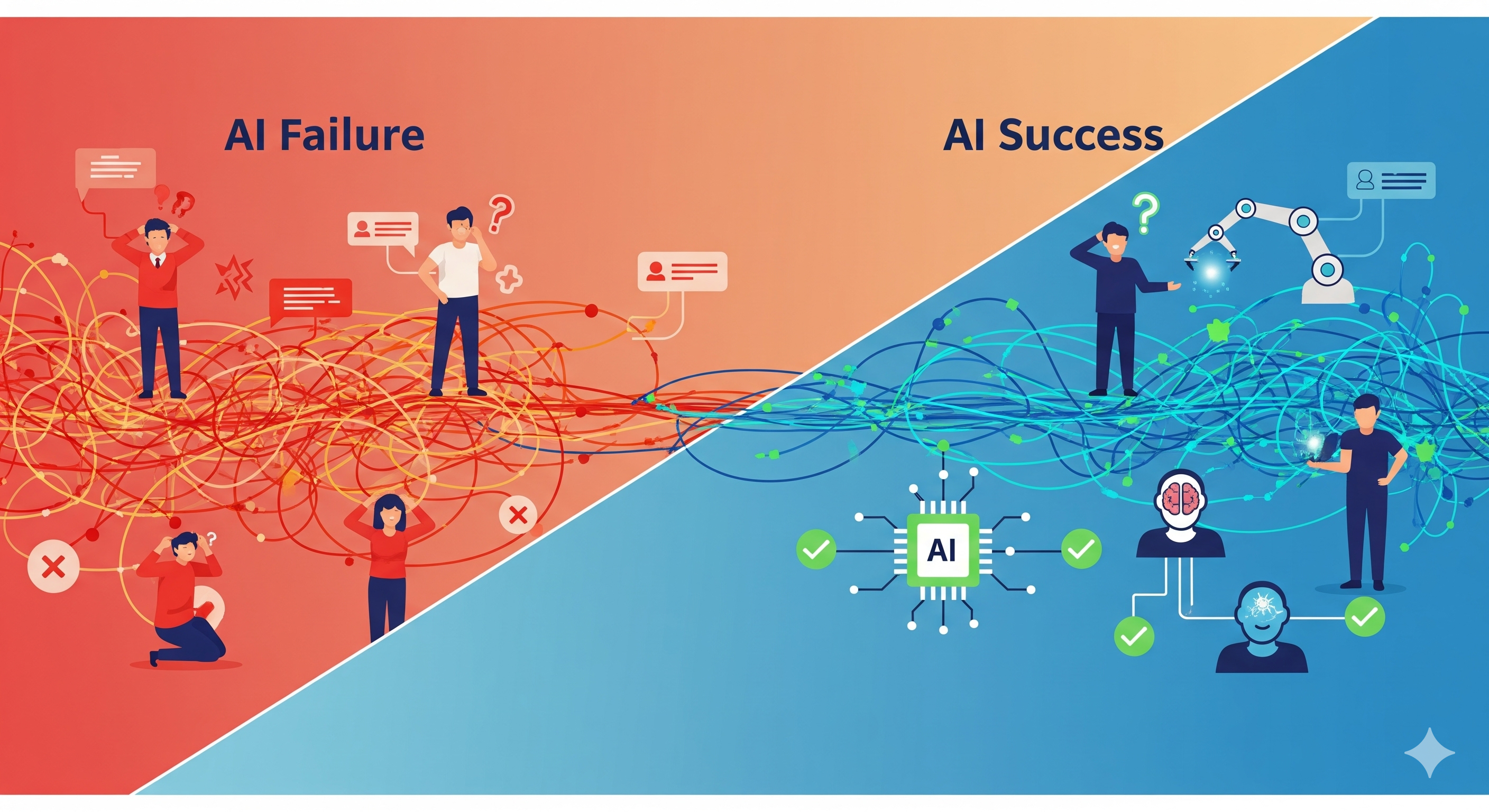
The headlines hit like a cold shower: “MIT Report: 95% of generative AI pilots at companies are failing.” LinkedIn feeds exploded with doom-and-gloom takes. “The AI bubble is bursting,” they declared. “We told you it was all hype.”
But here’s the thing about viral panic stories: everyone focuses on the wrong part.
While the internet obsessed over the 95% failure rate, they completely missed the real story. What did that elite 5% of companies do differently? What separates the winners from the $30-40 billion in wasted enterprise spending?
After digging into MIT’s NANDA initiative report “The GenAI Divide: State of AI in Business 2025,” the answer isn’t what you’d expect. The winners aren’t the biggest spenders or the companies with the fanciest models. They’re the smartest strategists.
The Real Problem Isn’t Technical—It’s Strategic
Most companies treat AI like a miracle cure they can slap onto broken processes. They’re essentially putting lipstick on a pig, then wondering why it doesn’t suddenly become beautiful.
The pattern is predictable: throw money and models at complex, siloed workflows without fixing the underlying mess. The result? What industry analysts have termed the “verification tax”—employees spending more time fact-checking AI output than they would have spent doing the original work themselves.
The successful 5% saw this trap coming from miles away. They understood that even the most sophisticated algorithm will fail if deployed within chaotic, poorly defined workflows.
So what did they do differently?
The Playbook That Actually Works
1. They Solved Specific Problems, Not Everything at Once
While most companies launched vague “GenAI for everything” initiatives, top performers laser-focused on single, measurable pain points.
Take Walmart’s approach: instead of “exploring AI possibilities,” they used machine learning to tackle their $60 billion inventory forecasting problem. Clear problem, clear metrics, clear financial impact.
Financial services firms deployed AI for fraud detection—high transaction volume, well-defined success criteria, immediate ROI measurement capability.
The winning strategy wasn’t “let’s see what AI can do.” It was “let’s reduce fraud by 15% using AI” or “let’s cut inventory waste by $2 billion using predictive analytics.”
This focus provided two critical advantages: crystal-clear execution roadmaps and objective success measurement.
2. They Built Data Moats, Not Model Hype
Here’s a counterintuitive truth: the best AI isn’t trained on the entire internet. It’s trained on your proprietary, meticulously structured internal data.
Companies like PepsiCo leveraged AI for personalized employee learning and development programs, grounded entirely in their internal workforce data. They treated their data as their most valuable competitive asset, not their choice of AI model.
These winners invested heavily in master data management systems, recognizing that poor data quality kills more AI projects than any technical limitation. While others drowned in data inconsistencies, the successful companies built what one industry expert called a “huge data moat.”
3. They Partnered for Speed and Expertise
The MIT research revealed that companies partnering with external AI vendors achieved 67% more successful deployments than those trying to build everything in-house.
The winners didn’t try to reinvent the wheel. They leveraged existing tools and expertise, using flexible, composable platforms that integrated with their current systems and could evolve over time.
Custom-built solutions from scratch? Recipe for disaster. Smart partnerships with proven vendors? Recipe for success.
4. They Embraced Human-AI Collaboration, Not Replacement
Most failed pilots suffer from what researchers call the “over-automation fallacy”—the misguided belief that AI should simply replace human workers. This approach destroys trust and creates organizational friction.
Successful companies flipped the script. They positioned AI as a recommendation engine, keeping humans in the decision loop for critical judgments. Rather than replacing human intelligence, they augmented it.
Walmart’s successful deployment included comprehensive employee training, helping workers understand how to leverage AI tools to optimize their performance rather than fear replacement.
This approach transforms AI from an existential threat into an empowering assistant, driving adoption rates through the roof and delivering measurably better results.
The Real Revolution Is Just Getting Started
That 95% failure rate isn’t evidence that AI is a fad. It’s a symptom of institutional unpreparedness and strategic shortsightedness.
The real story emerging from MIT’s research isn’t that most companies are failing—it’s that a smart minority is winning big by taking a fundamentally different, more strategic approach.
The AI gold rush mentality is over. The sustainable mining operation has just begun.
The next time you see breathless headlines about AI pilot failures, remember the quiet lesson of the successful 5%. The companies winning the AI game aren’t chasing the most expensive models or the flashiest features. They’re playing a completely different game: strategic focus, data discipline, and human-centered design.
That’s not just a better approach to AI. That’s a better approach to business transformation, period.
Filed under Artifical Intelligence.