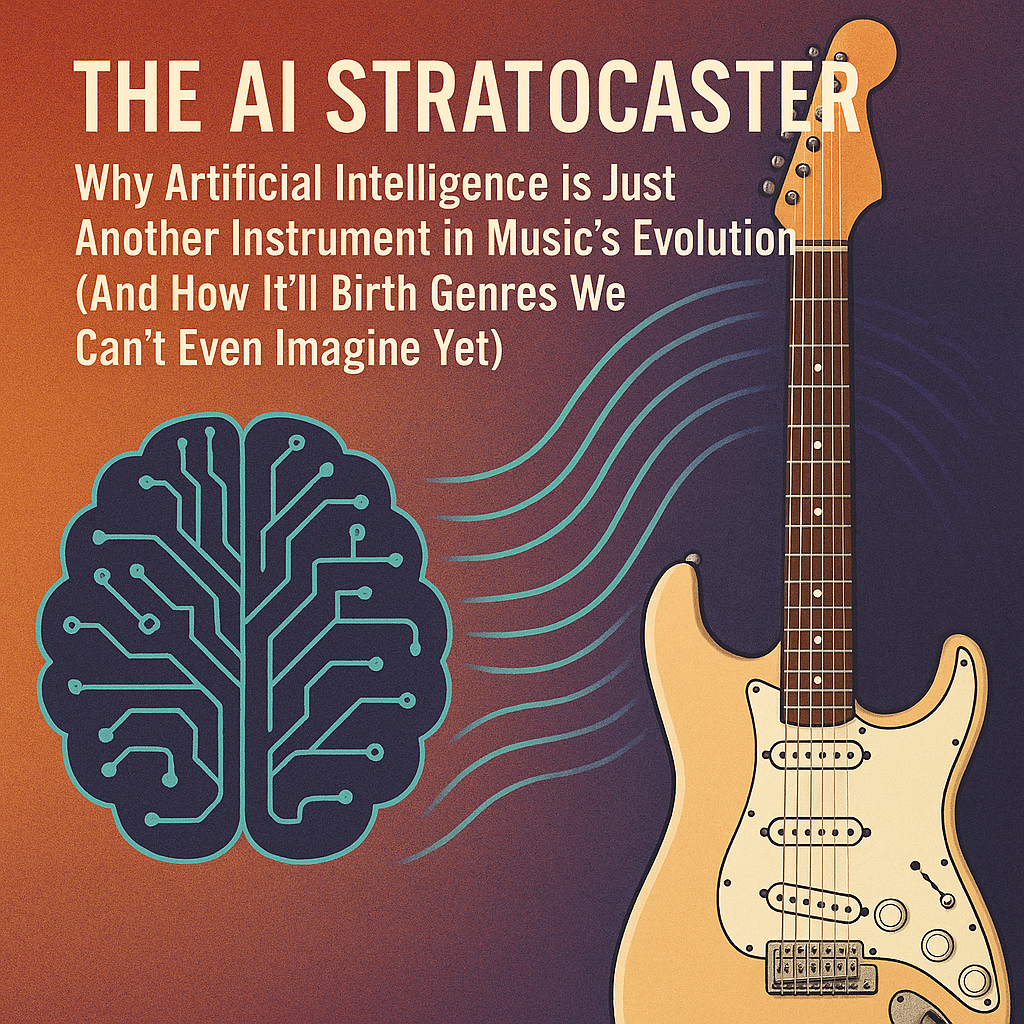
The AI Stratocaster: Why Artificial Intelligence is Just Another Instrument in Music's Evolution (And How It'll Birth Genres We Can't Even Imagine Yet)
The Great Moral Panic: A Historical Tradition in Music Tech
Every generation of musicians faces its existential crisis—that moment when purists declare new technology will destroy artistry. When Bob Dylan went electric at Newport in 1965, folk traditionalists screamed “Judas!”—conveniently forgetting acoustic guitars were once radical tech too. When synthesizers emerged, orchestras predicted the death of “real” instruments. HipHop’s sampling pioneers faced lawsuits for “stealing” music. Even AutoTune sparked endless debates about authenticity. As one musician noted: “The same thing happened to me when I started using virtual instruments… I wouldn’t wear it to drive a long journey or enjoy at home, savouring every nuance” .
The pattern is unmistakable:
- Radical Tool Emerges (electric guitar, 808, DAW)
- Moral Panic Erupts (“This isn’t real music!”)
- Creative Adoption (innovators bypass gatekeepers)
- Genre Revolution (rock, EDM, trap)
AI music generators like Suno and Udio are phase four—instruments with neural networks instead of strings. They democratize creation, letting anyone generate compositions from text prompts, much like drum machines allowed non-drummers to craft beats . The hysteria surrounding Velvet Sundown’s AI-generated indie rock mirrors past techno-phobia, ignoring how technology always expands creative possibility .
Tools of Rebellion: How Music Tech Always Sparks Revolution
| Era-Defining Tool | Initial Backlash | Genre Created | AI Equivalent |
|---|---|---|---|
| Electric Guitar (1950s) | “Not real blues!” | Rock & Roll | AI vocal cloning (Grimes’ Elf.Tech) |
| Roland TR-808 (1980) | “Robots can’t groove!” | HipHop/Electro | AI beat generators (Soundful) |
| ProTools (1991) | “Sterile sound!” | Modern Pop | AI mixing suites (iZotope’s Neutron) |
| Auto-Tune (1997) | “Cheating!” | Hyperpop/Trap | Emotion-synthesizing algorithms (Google Magenta) |
Today’s AI tools function identically: augmenting human limitations. Google’s Magenta helps composers explore chord progressions instantly—like having Hendrix’s melodic intuition on tap. Soundful’s AI generates royalty-free EDM backgrounds, mirroring how synths birthed ambient music . As one producer notes, “AI handles technical tasks like mixing/mastering… freeing artists for conceptual work” . This isn’t replacement—it’s creative delegation.
The Unheard Future: Genres Only AI Can Birth
AI’s power lies in smashing musical constraints to create genres physically impossible for humans:
1. Latent Space Opera
Imagine vocal harmonies shifting timbre mid-note—from Freddie Mercury’s vibrato to Björk’s whisper—within a single phrase. Tools like Holly Herndon’s Holly+ enable “decentralized authorship” where anyone “sings” through her AI model . Future artists will layer AI-cloned voices into choirs no human could coordinate, generating microtonal harmonies beyond 12-tone scales .
2. Neuro-Responsive Composition
AI will create music adapting to listeners’ biometrics in real-time. Startups like Endel craft soundscapes reacting to heart rate, but next-gen tools will generate dynamic symphonies where tempos sync to your walking pace . Concerts will become AI-conducted experiences with instruments responding to crowd movement .
3. Algorithmic Jazz
Unlike human jazz musicians, AI can improvise across 100+ simultaneous time signatures while maintaining groove. Projects like MorpheuS morph musical tension mathematically, enabling solos that evolve fractally—each phrase branching into variations humans couldn’t conceive .
4. Cross-Species Soundscapes
By training models on bioacoustic datasets—whale songs, bat echolocation—AI will compose “translational music” rendering non-human communication audible. Imagine albums where AI interprets rainforest soundscapes into orchestral arrangements .
The Ethical Bridge: Navigating AI’s New Frontier
Critics rightly flag concerns about voice cloning without consent and copyright ambiguity . But history shows legal systems adapt:
- Sampling lawsuits birthed clearance systems
- MP3 piracy led to streaming royalties
- AI necessitates “neural licensing” frameworks
Solutions are emerging: Grimes’ 50% royalty split for AI voice usage offers one model. Startups like Kits AI enable singers to license vocal models securely. As CISAC President Björn Ulvaeus warns:
“AI has the power to unlock opportunities—but if badly regulated, it could cause great damage” .
The goal is ethical augmentation—treating AI like a Stratocaster, not a ghostwriter.
The Verdict: Another Tool, Another Renaissance
Velvet Sundown’s viral success proves AI can replicate musical forms—but not artistic intent. Their lyrics were criticized as “empty slogans” lacking human subtext , exposing AI’s core limitation: it assembles patterns but doesn’t live them.
The future belongs to cyborg artists:
- Producers weaving AI textures into human narratives
- Singers duetting with digital clones
- Composers directing algorithmic orchestras
As one musician experimenting with Suno AI reflects:
“It’s fun… but I wouldn’t wear it to drive a long journey or enjoy at home” .
That’s the essence: AI is the newest pedal on our effects board—awaiting its Hendrix to make it weep. The next Blonde on Blonde or Illmatic won’t be AI-generated… but it’ll be AI-enhanced.
“The best tools disappear into creativity. No one hears the Auto-Tune on Cher’s ‘Believe’ anymore—they feel the ache. Soon, we won’t ‘hear’ AI—we’ll feel new emotions only it can evoke.”
— Experimental producer quoted in The Impact of Artificial Intelligence on Music Production
🔥 Sound the Alarm: Share this to reframe the AI music debate.
Written by a human who still believes in feedback-drenched guitar solos.
Visual: [Infographic comparing AI music milestones from ILLIAC Suite (1957) to Velvet Sundown (2025)]
Alt-text: From Algorithms to Americana - AI’s 70-Year Overture.
Filed under Artifical Intelligence.