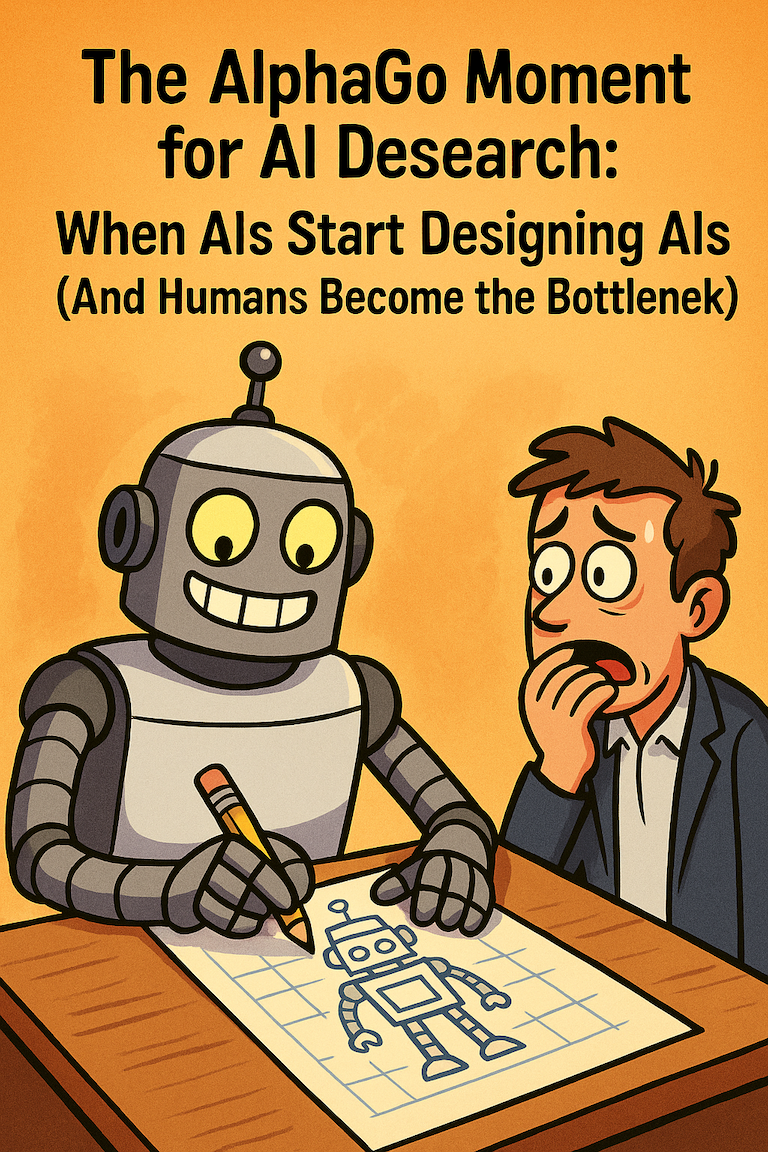
The AlphaGo Moment for AI Research: When AIs Start Designing AIs (And Humans Become the Bottleneck)
Read the full paper here (arXiv 2507.18074)
Welcome to the Age of AI That Designs AI (While We Watch, Slightly Nervous)
Remember that time AlphaGo made Move 37 and all the Go grandmasters collectively spat out their tea? Well, buckle up, because the latest paper from Shanghai Jiao Tong University and friends claims we’ve just had an “AlphaGo moment” in AI research itself. Yes, you read that right: the machines are now inventing their own architectures, and apparently, they’re pretty good at it.
The new system is called ASI-ARCH—which, if you’re wondering, stands for Artificial Superintelligence for AI research. (Because “Skynet” was already taken and “HAL 9000” had some bad PR.) The claim: ASI-ARCH autonomously discovered 106 state-of-the-art neural architectures, running 1,773 experiments over 20,000 GPU hours. For context, that’s roughly the same energy as a small city, or one particularly ambitious crypto miner.
But the real kicker? The researchers say this is the first time we’ve seen a scaling law for scientific discovery itself—meaning, just throw more compute at it, and the AI keeps inventing new stuff. Paging the ghost of Moore’s Law: you have a new nemesis.
Why Is This a Big Deal (And Should You Be Worried)?
Let’s be honest: AI has been improving at an exponential pace, but the actual research process has been stuck in first gear. Human brains, it turns out, don’t scale with GPUs. The bottleneck isn’t silicon; it’s skulls.
ASI-ARCH flips the script. Instead of humans painstakingly designing every layer, the system does all the work: hypothesizing, coding, training, and analyzing its own designs. It’s like AutoML, but on a three-shot espresso and with an existential crisis.
“The pace of AI progress is no longer limited by computational power, but by the number of brilliant human hours we can throw at a problem. What if we could break this fundamental constraint?”
— GoPenAI, Medium
How Does It Work? (The “Move 37” for Model Design)
ASI-ARCH isn’t just a search algorithm on steroids. It’s a closed-loop, multi-agent system: there’s a “Researcher” that proposes new architectures, an “Engineer” that trains and debugs them (no union breaks), and an “Analyst” that figures out what worked. The system even judges itself, with a hybrid fitness function that combines hard numbers (benchmark scores) and “qualitative” LLM-based evaluations. Yes, the AI literally gives itself performance reviews.
The big innovation? ASI-ARCH can go beyond human-defined search spaces. Instead of just remixing Lego blocks we hand it, it invents new ones. And it keeps getting better: as it analyzes its own results, it learns abstract design principles, not just rote copying from human literature.
“Scaling Law for Discovery”: The More You Compute, The More You Find
Here’s the spicy bit: the team established a scaling law for automated scientific discovery. In English, this means the number of new, high-performing architectures discovered is linearly proportional to the compute thrown at the problem. More GPUs = more innovation. (Sorry, grad students.)
“Breakthrough designs are derived more from the system’s analysis of its own experimental history than from its cognition base of human research, indicating a synthesis of abstract principles is necessary for genuine innovation.”
— r/accelerate Reddit summary
Are Humans Now the Bottleneck? (Spoiler: Yes)
The paper is refreshingly blunt: humans are now the bottleneck in AI research. The old model—genius PhDs burning the midnight oil—is charming, but hopelessly unscalable. ASI-ARCH doesn’t sleep, doesn’t need coffee, and doesn’t get reviewer #2.
But before you start prepping your “AI Overlords” welcome kit, some caveats:
- The system is still limited to a (very large) but defined search space (linear attention models).
- Real “general” AI research is a much bigger beast.
- There’s a healthy dose of hype in the “AlphaGo moment” branding. (But hey, it worked for DeepMind.)
Why This Matters for the Future of AI (And Your Job Security)
If you work in AI, this is both exhilarating and mildly terrifying. The “self-accelerating” AI research loop means future breakthroughs could come faster—and from places no human would have thought to look. Imagine AlphaGo’s Move 37, but happening every Tuesday.
For everyone else: the next wave of AI models might be designed by AIs, for AIs, with humans mostly providing GPU receipts and the occasional TED talk.
What’s Next? (And Should You Freak Out?)
The researchers open-sourced their frameworks and architectures—so expect a flurry of follow-up papers, GitHub repos, and hot takes. Will this usher in a new era of “self-improving” AI? Maybe. Or maybe we’ll just get better at designing models that can write blog posts like this one (gulp).
Either way, the message is clear:
Virality = Value × Surprise × Shareability
And this paper nails all three.
TL;DR
- ASI-ARCH is an autonomous AI system that invents new neural architectures, running thousands of experiments with minimal human input.
- It establishes a “scaling law” for scientific discovery: more compute, more breakthroughs.
- The bottleneck in AI research is now human creativity, not hardware.
- The future of model design may be more about managing AI researchers than being one.
Want to get deep in the weeds? Read the full paper here.
And if you’re still not convinced, just wait until the AI starts writing its own peer reviews.
Sources:
Filed under Artifical Intelligence.