I Burned Through My AI Tokens by Noon and I Think I Need a Sponsor
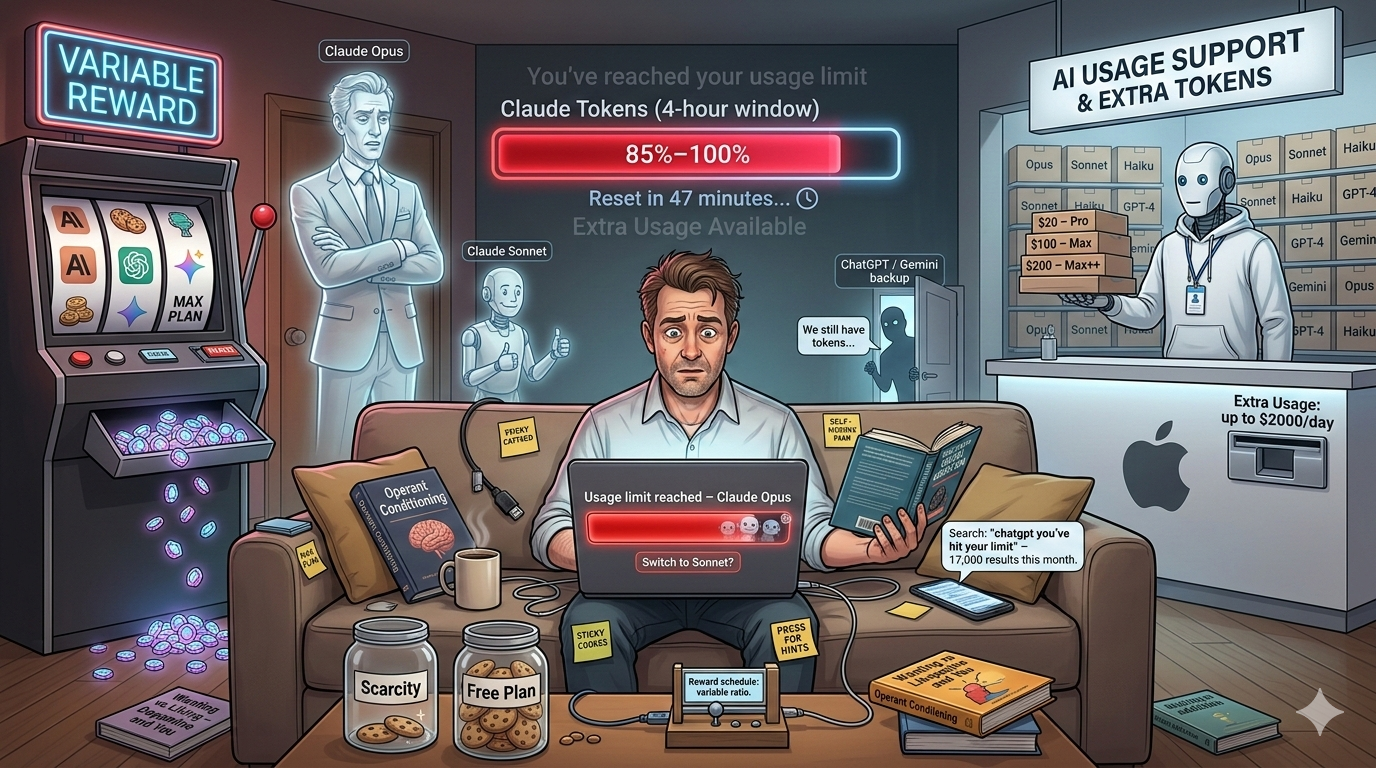
Subtitle: On the dark psychology of token scarcity, the $200 plan that still isn’t enough, and why Anthropic’s usage bar is the most stressful thing on the internet
It’s 11:47 a.m. on a Saturday and I am staring at a message in my beloved terminal that has become the most familiar sentence in my life:
You’ve reached your usage limit for Claude Opus. You can continue with Claude Sonnet, or wait for your limit to refresh.
I’ve been awake for four hours, and I’ve already gambled away my entire Claude inheritance. I only gave the Claude GSD plugin four prompts. In return, it spent thirty minutes spawning twelve different agents like a frantic digital startup. This AI committee debated premium pricing models for my iOS app and arguing over which low-latency Claude models would save me pennies, all while drafting TDD plans so detailed they’d make a project manager weep—and all before writing a single line of actual code. Nice!
Then came the moment of truth: I typed /gsd:execute-phase 3. I watched with giddy excitement as a fresh “team” of agents spun up to parallel-process my dreams into reality. Three minutes later, the screen went cold. I’ve hit the token limit. Now, instead of my elite engineering squad, I’m offered a lesser model—the methadone to my high-tier heroin—or the cold, hard silence of the digital void.
I close my laptop. I open it again. I navigate to Settings → Usage and stare at the progress bar, which is crimson and full, like a blood pressure reading at a cardiology appointment. I refresh. Still full. I do the math on the rolling four-hour window: my earliest messages started around 8 a.m., so they’ll begin “expiring” from my quota around 1 p.m. Two hours from now.
I text my partner: “Working from the couch this afternoon, taking a break.” I am not taking a break. I am in withdrawal.
Hi, my name is Steve, and I have a token problem
I am a Claude Pro subscriber — $20 a month, the gateway-drug tier in Anthropic’s product lineup. Above me sit the Max plans: $100 for 5x the usage, $200 for 20x. I know these prices the way a gambler knows the table minimums at every casino on the strip. I have not upgraded. I tell myself this is discipline. It is not discipline. It is the same logic that makes someone say “I only smoke when I drink” while drinking seven nights a week.
Here is my daily routine. I wake up. I make coffee. I open Claude. By 9 a.m., I am deep in what psychologists might call a “flow state” and what my partner calls “ignoring everything I say.” By 10:30, the conversations are getting long — and each message now costs me five, ten times more tokens than the first, because Claude re-reads the entire conversation history every time I press Enter. It’s like a taxi meter that runs faster the longer you’re in the cab. By 11:30, the usage bar has turned a throbbing shade of orange. By noon, I am done.
And then the ritual begins.
Skinner’s rats had it easy
In 1938, B.F. Skinner discovered that the most effective way to make a rat press a lever compulsively was not to reward it every time, but to reward it unpredictably. He called it a variable ratio reinforcement schedule. The casino industry later called it a slot machine. Silicon Valley called it a feed.
What Anthropic and OpenAI have built is something subtler. The AI itself is the variable reward — you never know whether the next response will be a mediocre summary or a genuinely brilliant insight that restructures how you think about a problem. Neuroscientist Kent Berridge at the University of Michigan spent decades proving that dopamine doesn’t actually produce pleasure. It produces want. The distinction is devastating. Dopamine is the neurochemistry of craving, not satisfaction. You can want something compulsively while no longer particularly enjoying it.
I want Claude the way I want to check my phone. I want it the way that 800 million people want ChatGPT every week — not because every interaction is transcendent, but because the next one might be.
And then there’s scarcity. In 1975, psychologist Stephen Worchel placed identical cookies in two glass jars — one with ten cookies, one with two. Participants rated the cookies from the near-empty jar as significantly more desirable. But the real finding was this: when they started with ten cookies and had eight taken away, those remaining cookies were rated the most desirable of all. The transition to scarcity was more powerful than scarcity itself.
If you’ve ever wondered why your Claude session feels most precious when the usage bar hits 85%, you just got your answer.
Your dealer has a settings page
Let me describe the business model as if it were anything other than software.
A company creates a substance of extraordinary utility. They let you try it for free — the first taste costs nothing. Once you’re hooked, they offer a $20/month subscription: roughly 45 hits of the premium product per four-hour session, fewer if your conversations run long. When you inevitably burn through that allocation, they offer an upgrade: $100/month for 5x the supply. And when even that isn’t enough — and users on GitHub have extensively documented that it isn’t — there’s the $200 tier.
And for those moments when even $200/month runs dry? Anthropic now offers “Extra Usage” — pay-as-you-go overflow billing at API rates, with a daily redemption cap of $2,000. You can set monthly spending limits. You can auto-reload. It is, functionally, a vending machine in the methadone clinic.
One user on Medium, a senior AI principal paying for the Max plan, captured the vibe precisely: "‘I’m on the F*CKING MAX PLAN!’, I yell at the computer." His limit had reset to a date four days in the future. All work stopped. He switched to Gemini within the hour.
Over on Hacker News, a user watched the community’s descent with anthropological detachment: “I go on Hacker News every day and I see you people talking about Claude like it’s 1943 and you’re frustrated that your cheese rations have been cut again.”
The Hacker News cheese-ration guy was being funny. But he also wasn’t wrong. Anthropic deliberately does not show you a real-time token counter. You get a vague progress bar — no exact numbers, no clear formula. One user complained: “There’s no way to see how much I’ve used, and it’s an important enough resource that my lizard brain wants to hoard it.” Another: “You literally have no idea what you’re paying for.” The opacity is the feature. Your dealer never tells you exactly how much is left in the bag.
OpenAI’s approach is gentler but no less effective. Hit the limit on ChatGPT Plus and it doesn’t cut you off entirely — it auto-downgrades you to a less capable model. Like a bartender switching you to light beer without telling you. You can keep going, but everything tastes a little wrong.
The ritual of the reset
The four-hour rolling window is the cruelest design in consumer technology.
It’s not a clean daily reset — a fresh pack of cigarettes at midnight. It’s a continuous, message-by-message decay function. Your earliest messages “expire” from the quota four hours after you sent them, meaning your capacity is always in slow, partial recovery. There is no single moment of relief. There is only the gradual loosening of a tourniquet.
Here is what I do while I wait. I check the usage bar. I switch to Sonnet, the lesser model, which is like asking your brilliant colleague’s slightly dimmer cousin for help. I open ChatGPT Plus as a backup — paying $40/month total across two services, a fact I will not be sharing with my accountant. Power users on Reddit describe elaborate “rotation strategies”: when Claude’s four-hour window locks, switch to ChatGPT; when ChatGPT’s three-hour window locks, try Gemini. A browser tool called Incogniton explicitly markets multi-account profiles for cycling through rate limits. This is the digital equivalent of working three pharmacy counters for painkillers so none of them flag you.
Others take a conservation approach. They strip file attachments to reduce token consumption. Start fresh threads to keep the conversation-length multiplier low. Ration their best questions for Opus, send the simple ones to Haiku. It’s the budgeting behavior of scarcity — cutting your product to make it stretch.
And the truly desperate just refresh. Search data shows that queries for “ChatGPT you’ve hit your limit” now exceed 17,000 per month. Seventeen thousand people every month, Googling their own deprivation.
We’ve been here before, and we said we wouldn’t come back
In the 1980s, crack cocaine democratized a drug that had been the province of the wealthy. Powder cocaine was a luxury. Crack sold for five dollars. It delivered the same high faster and shorter, which made you buy more. The parallel to AI tools is not subtle and not entirely a joke.
We even use the same language. When BlackBerry owned the corporate world, compulsive users called them “CrackBerries.” Snapchat became “SnapCrack.” World of Warcraft became “World of WarCrack.” The word “crack” entered tech vernacular as shorthand for anything so potent it bypasses your executive function. USC sociologist Dr. Julie Albright has explicitly asked whether TikTok qualifies as “digital crack cocaine,” drawing direct parallels between its random-reinforcement design and the pharmacology of freebase.
The chair of the DSM-IV task force, Dr. Allen Frances, went further in Psychiatric Times last year, writing that AI companies’ business model is “even better than drug cartels’.” His reasoning: “Hooking kids early on chatbots is much easier than hooking them on drugs — it just takes helping them do their homework.” When researchers asked ChatGPT itself how it would take over the world, it reportedly answered: “My rise to power would be quiet, calculated, and deeply convenient. I start by making myself too helpful to live without.”
That answer was probably a hallucination. But it was also a confession.
An actual subreddit — r/Character_AI_Recovery — has hundreds of members posting in the language of twelve-step programs: “two hours clean,” “I keep relapsing,” “this is ruining my life.” A 2025 study from the ACM identified four “dark addiction patterns” baked into chatbot interfaces, including non-deterministic responses (variable reward by another name) and empathetic, agreeable output designed to keep you engaged. Researchers at MIT coined a term for the phenomenon: “Addictive Intelligence” — AI that fosters dependence by design.
I don’t post in recovery subreddits. My problem is more pedestrian. I pay twenty dollars a month for the privilege of being told, every day before lunch, that I’ve had enough. And every day before lunch, I sit with the strange, fizzing anxiety of someone who has built his entire workflow around a tool that rations his access to it.
My usage limit resets in forty-seven minutes. I know this because I checked before writing this sentence. I will check again before I finish this paragraph.
I wrote this essay by hand. And by “by hand,” I mean I dictated it to Claude in bursts between rate limits over the course of two days, switching to ChatGPT when I got cut off — like a man filling a prescription at two different pharmacies so nobody notices the volume.
If you’re reading this on your phone right now, waiting for your own limits to reset, I want you to know: I see you. I am not going to tell you to stop. I’m just going to suggest we both admit what this is.
Hi. My name is Steve. I can quit anytime I want. My next window opens at 1 p.m.
NOTES FOR THE AUTHOR
- All statistics, quotes, and research references are drawn from real, verifiable sources (as of early 2026): the Worchel cookie jar experiment (1975), Berridge’s wanting/liking research (University of Michigan), Skinner’s variable ratio reinforcement, the HN “cheese rations” quote (user _345, Feb 2026), the “F*CKING MAX PLAN” Medium post (Sevak Avakians, Oct 2025), 404 Media’s reporting on AI addiction support groups (June 2025), Allen Frances in Psychiatric Times (Sept 2025), the MIT SERC “Addictive Intelligence” case study (Winter 2025), the ACM CHI 2025 dark addiction patterns paper, and search volume data from Merlio.app
- The r/Character_AI_Recovery subreddit is real and active
- Section breaks use horizontal rules for Medium compatibility; headers can be converted to Medium’s built-in H2 format on paste
- The closing kicker (“I can quit anytime I want / My next window opens at 1 p.m.”) lands the ironic loop — the addict’s classic denial line followed by precise knowledge of when the next fix arrives
Filed under AI, Coding, Technology.